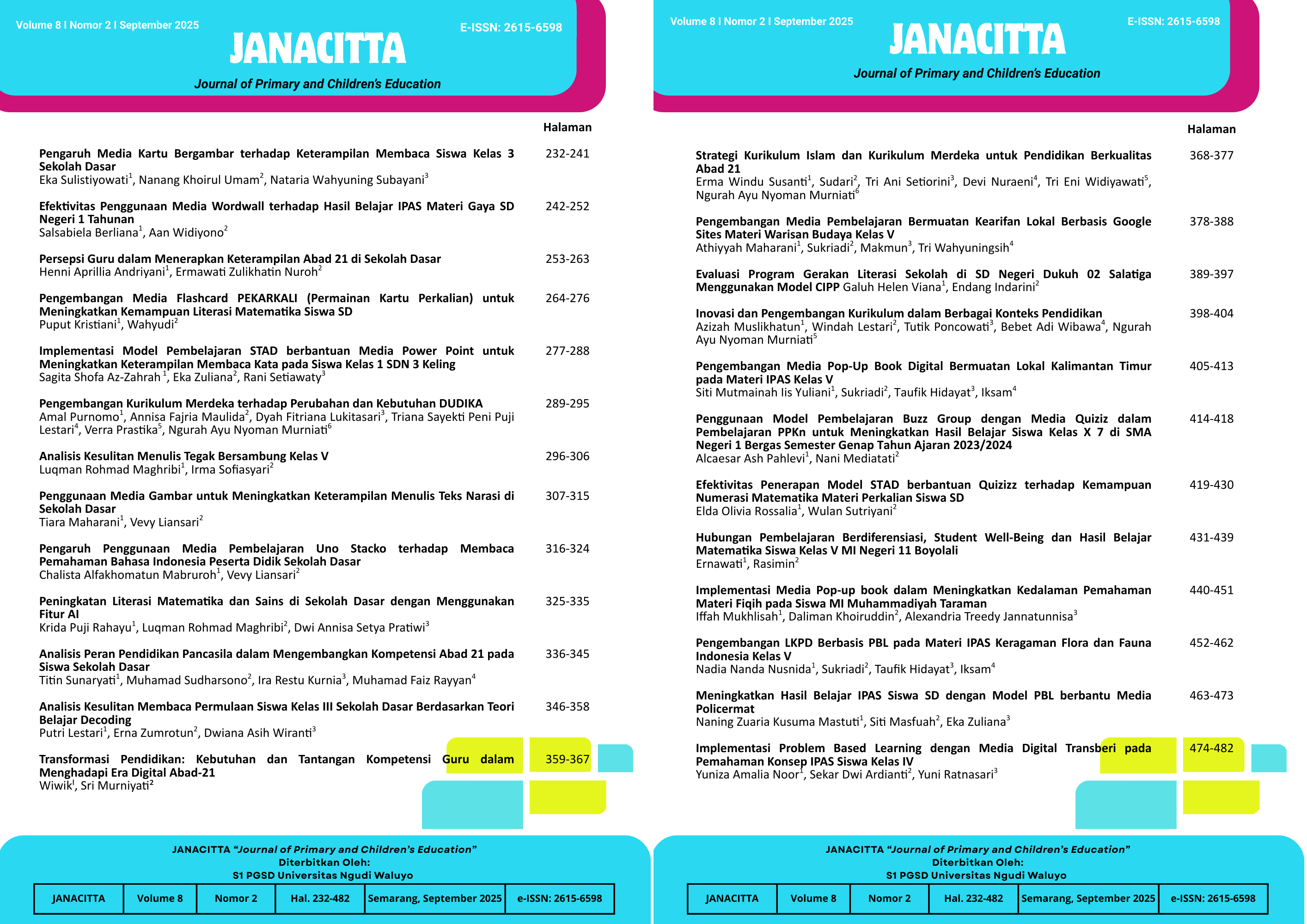
Evaluasi Program Gerakan Literasi Sekolah di SD Negeri Dukuh 02 Salatiga Menggunakan Model CIPP
DOI:
https://doi.org/10.35473/janacitta.v8i2.4012Keywords:
Evaluation, Literacy, CIPPAbstract
Abstract
This study describes the Implementation, Obstacles and Challenges as well as the Recommendations of the School Literacy Movement Program at Dukuh 02 Public Elementary School, Salatiga. This study uses descriptive qualitative research using the CIPP model. Data collection techniques used through interviews, observations, and document studies conducted with supervisors, principals, teachers, and students. The results of the study indicate that the implementation of the School Literacy Movement Program has been running quite well with routine activities of 15-minute learning habits as pre-learning activities, the provision of reading corners, the use of digital books. However, several obstacles were still found such as limited digital access and low interest in reading in some students. The recommendation given is to have a daily journal that helps students to more easily understand the content of the reading. The results of the study show that all data collection instruments (Interviews, Observations, and Document Studies) have been validated with very valid criteria with a percentage value of 97%.
Abstrak
Penelitian ini mendeskripsikan mengenai Implementasi, Hambatan dan Tantangan serta Hasil Rekomendasi dari Program Gerakan Literasi Sekolah di SD Negeri Dukuh 02 Salatiga. Penelitian ini menggunakan penelitian kualitatif deskriptif menggunakan model CIPP. Teknik pengumpulan data yang digunakan melalui wawancara, observasi, dan studi dokumen yang dilakukan terhadap pengawas, kepala sekolah, guru, dan peserta didik. Hasil penelitian menunjukkan bahwa pelaksanaan Program Gerakan Literasi Sekolah sudah berjalan cukup baik dengan kegiatan rutin pembiasaan pembelajaran 15 menit sebagai kegiatan pra-pembelajaran, penyediaan pojok baca, penggunaan buku digital. Namun masih ditemukan beberapa kendala seperti keterbatasan akses digital dan rendahnya minat baca pada sebagian siswa. Rekomendasi yang diberikan yaitu dengan adanya jurnal harian yang membantu siswa untuk dapat lebih mudah memahami isi bacaan. Hasil penelitian menunjukkan bahwa seluruh instrumen pengumpulan data (Wawancara, Observasi, dan Studi Dokumen) telah tervalidasi dengan kriteria sangat valid dengan nilai persentase 97%.
References
Akbar, Aulia. (2017). Membudayakan Literasi dengan Program 6M di Sekolah Dasar. JPSD, 3(1), 42-52.
Fangestika, Devi. (2018). Pelaksanaan Gerakan Literasi di Sekolah. Jurnal Pendidikan Guru Sekolah Dasar Edisi, 7(35), 3501-3508.
Kemendikbudristek. (2023). Literasi Membaca, Peringkat Indonesia di PISA 2022. Laporan PISA Kemendikbudristek, 1–25.
Kristiani, Puput & Wahyudi. (2025). Pengembangan Media Flashcard PEKARKALI (Permainan Kartu Perkalian) untuk Meningkatkan Kemampuan Literasi Matematika Siswa SD. JANACITTA, 8(2), 264–276.
Miles, Matthew B., Huberman, A. Michael, Saldana, Johnny. (2014). Qualitative Data Analysis : a Sourcebook of New Methods (4 Edition). Los Angeles: Sage.
Kemendikbud. (2017). Panduan Gerakan Literasi Nasional. Jakarta Timur: Kementerian Pendidikan dan Kebudayaan.
Setiawan, Roosie, Komalasari, Misiyanto, Mardianto, Agus, Islami, Audina, Nurani, Dwi. (2019). Panduan Gerakan Literasi Sekolah di Sekolah Dasar. Discussion Paper. Jakarta: Kemendikbud
Hasanah, Uswatun, & Mirdat Silitonga. (2020). Implementasi Gerakan Literasi Sekolah di Sekolah Dasar. Jakarta: Kemendikbud.
Ramandanu, F. (2019). Gerakan Literasi Sekolah (GLS) melalui Pemanfaatan Sudut Baca Kelas sebagai Sarana Alternatif Penumbuhan Minat Baca Siswa. Mimbar Ilmu, 24(1), 10-19.
Retnaningdyah, Pratiwi, D. (2016). Gerakan Literasi Sekolah di Sekolah Menengah Pertama. Jakarta: Direktorat Pembinaan Sekolah Menengah Pertama Direktorat Jendral Pendidikan Dasar dan Menengah Kementrian Pendidikan dan Kebudayaan.
Stufflebeam, D. L., & Shinkfield, A. J. (1985). Systematic Evaluastion a Self-Instructional Guide to Theory and Practice. Norwell Nort America: Kluwer-Nljhoff Publishing.
Subur, S. & Wahidiyati, I. (2022). Dampak Psikologis Pembelajaran Daring di Sekolah Dasar. Al-TA'DIB: Jurnal Kajian Ilmu Kependidikan, 15(2), 79–88.
Downloads
Published
How to Cite
Issue
Section
License
Copyright notice:
- Authors retain copyright and grant the journal right of first publication with the work simultaneously licensed under Creative Commons Attribution License that allows others to share the work with an acknowledgement of the work's authorship and initial publication in this journal.
- Authors are able to enter into separate, additional contractual arrangements for the non-exclusive distribution of the journal's published version of the work (e.g., post it to an institutional repository or publish it in a book), with an acknowledgement of its initial publication in this journal.
- Authors are permitted and encouraged to post their work online (e.g., in institutional repositories or on their website) prior to and during the submission process, as it can lead to productive exchanges, as well as earlier and greater citation of published work (The Effect of Open Access)