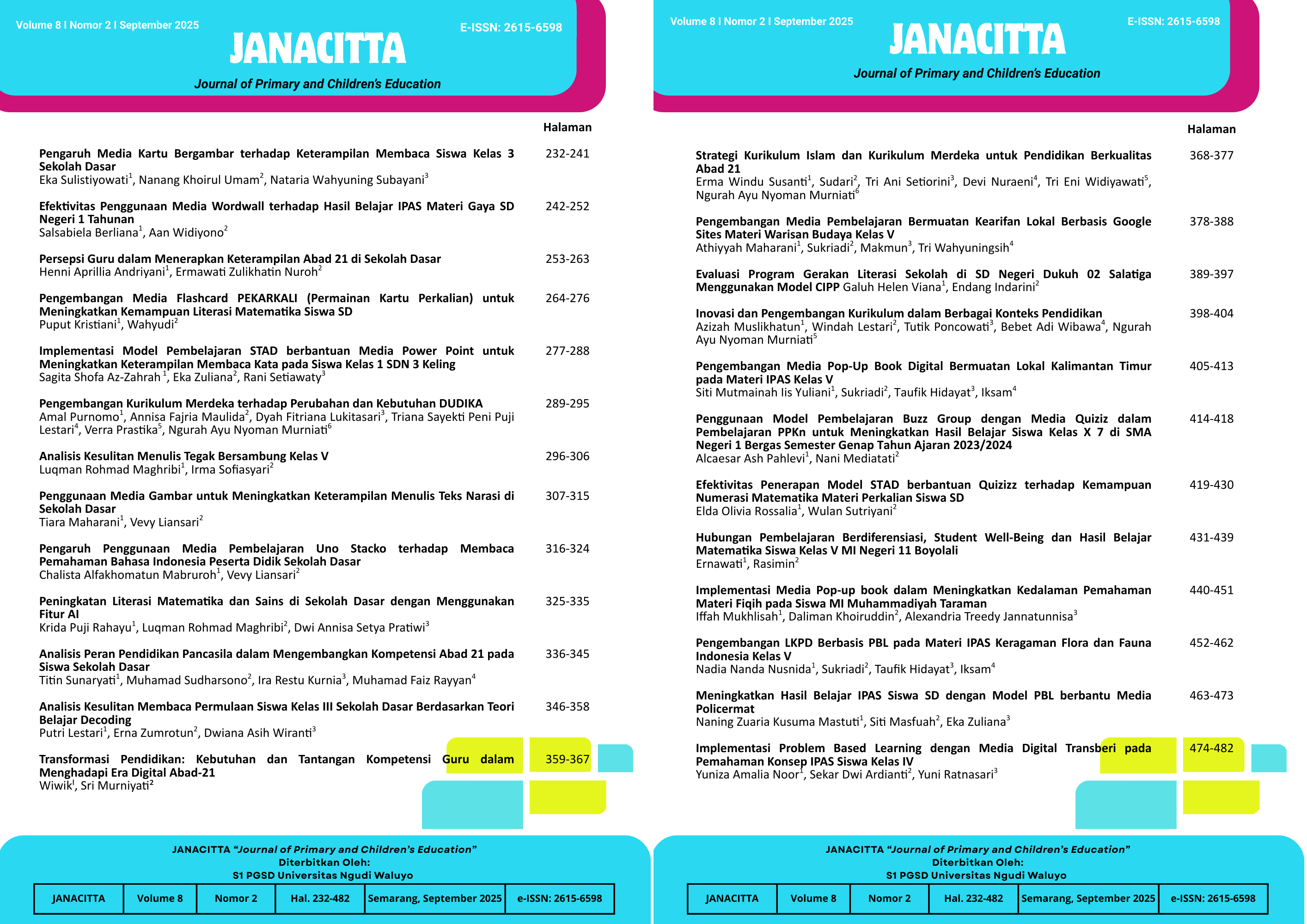
Peningkatan Literasi Matematika dan Sains di Sekolah Dasar dengan Menggunakan Fitur AI
DOI:
https://doi.org/10.35473/janacitta.v8i2.4040Keywords:
Mathematics and Science Literacy, Elementary Schools, Artificial Intelligence (AI)Abstract
Abstract
This study aims to explore ways to efficiently use artificial intelligence (AI) features to improve mathematics and science literacy in elementary school students. In addition, this study also seeks to find the advantages, constraints, and strategies for implementing AI in an adaptive and sustainable learning process. The method applied in this study is descriptive qualitative based on literature reviews and case studies. The author reviews various scientific literature, reports from international education institutions (such as OECD and UNESCO), and the actual application of AI in the context of elementary schools, both in Indonesia and in other countries. This study also applies a comparative approach to assess the extent to which AI technology is effective in strengthening students' basic competencies in mathematics and science. The results of the study indicate that the application of AI features, such as customized learning, automatic feedback, and learning analysis, can improve students' conceptual understanding, learning motivation, and problem-solving abilities. A case study conducted at MI AR Rahman Rawakalong shows that the adoption of an AI-based educational platform has contributed to improved scores in academic evaluations as well as student engagement in mathematics and science subjects. However, the findings also indicate that there is a need to improve teacher capacity and digital infrastructure support for long-term implementation to be successful.
Abstrak
Penelitian ini bertujuan untuk mengeksplorasi cara-cara penggunaan fitur-fitur kecerdasan buatan (AI) secara efisien dalam memperbaiki literasi matematika dan sains pada murid sekolah dasar. Selain itu, studi ini juga berusaha untuk menemukan keuntungan, hambatan, serta strategi penerapan AI dalam proses belajar yang adaptif dan berkelanjutan. Metode yang diterapkan dalam penelitian ini adalah deskriptif kualitatif yang didasarkan pada kajian pustaka dan studi kasus. Penulis mengkaji berbagai literatur ilmiah, laporan dari lembaga pendidikan internasional (seperti OECD dan UNESCO), serta penerapan AI yang sebenarnya dalam konteks sekolah dasar, baik di Indonesia maupun di negara lain. Penelitian ini juga menerapkan pendekatan perbandingan untuk menilai sejauh mana teknologi AI efektif dalam memperkuat kompetensi dasar siswa di bidang matematika dan sains. Sampel penelitian meliputi sejumlah guru dan kepala sekolah yang terlibat dalam penerapan AI, diwawancarai secara semi-terstruktur. Selain itu, digunakan data hasil belajar siswa yang terlibat dalam intervensi AI sebagai sampel kuantitatif. Hasil penelitian membuktikan bahwa penerapan fitur AI terbukti efektif meningkatkan rata-rata skor literasi matematika sebesar 18% dan sains sebesar 14%, sekaligus memperkuat motivasi belajar siswa, meskipun keberhasilan jangka panjang sangat bergantung pada penguatan infrastruktur digital dan pelatihan guru. Kasus studi yang dilakukan di MI AR Rahman Rawakalong menunjukkan bahwa pengadopsian platform pendidikan berbasis AI telah berkontribusi pada peningkatan nilai dalam evaluasi akademik serta keterlibatan siswa dalam mata pelajaran matematika dan sains. Namun, temuan juga menunjukkan bahwa ada kebutuhan untuk meningkatkan kapasitas guru dan dukungan infrastruktur digital agar penerapan jangka panjang dapat berhasil.
References
Braun, V., & Clarke, V. (2021). Thematic Analysis: A Practical Guide. SAGE Publications.
Chassignol, M., Khosravi, H., Chen, L., & Sadiq, S. (2021). Impact of Artificial Intelligence on the Future of Education: A Systematic Review and Research Agenda (2nd ed.). International Journal of Educational Technology in Higher Education, 18(1), 1–46.
Cokyasar, T. (2021). Science Direct Delivery Drone Route Planning Over a Battery Swapping Network. Procedia Computer Science, 184, 10–16.
Creswell, J. W., & Creswell, J. D. (2023). Research Design: Qualitative, Quantitative, and Mixed Methods Approaches (6th ed.). California: SAGE Publications.
Holmes, W. (2020). A Scoping Review of the Effects of Artificial Intelligence in Education on Student Outcomes and Teachers’ Practice. Computers & Education, 155, 103931.
Hwang, G. J., & Fu, Q. K. (2020). A Review of Trends in Artificial Intelligence in Education (AIEd) Based on a Network Co-Citation Analysis. British Journal of Educational Technology, 51(3), 850–873.
Kementerian Pendidikan Riset, dan Teknologi, K. (2023). Laporan Implementasi Pendidikan Inklusif dan Digitalisasi Sekolah. Kemendikbudristek.
Know, W. S., & Do, C. A. N. (2018). PISA 2018 Results: Vol. I. OECD Publishing.
Kukulska-Hulme, A. (2020). AI and the Changing Landscape of Higher Education. International Journal of Educational Technology in Higher Education, 17(1), 1–13.
Larasati, T. S., & Widiarto, T. (2024). Peningkatan Motivasi Belajar Menggunakan Model Teams Games Tournament Mata Pelajaran IPAS Kelas V. JANACITTA, 7(1), 11–19.
Lee, M., Gweon, H., & Kim, M. S. (2021). Examining the Effects of an AI-Based Intelligent Tutoring System on Students’ Learning Performance and Motivation in Mathematics. Educational Technology & Society, 24(3), 1–15.
Maghribi, L. R., Fajrie, N., & W, S. S. (2023). Implementasi Model Pembelajaran Teams Games Tournament di SD Margorejo 01 Kecamatan Pati. Journal on Education, 05(03), 5917–5924.
Maghribi, L. R., Ismaya, E. A., & Kudus, U. M. (2024). Analisis Hambatan Belajar Siswa dalam Mata Pelajaran IPS Kelas V SD IT Nurul Fikri Kecamatan Trangkil Pati Memenuhi Standar Kelulusan Minimal pada Tata Cara Pembelajaran yang Tidak Digunakan dalam Media Pembelajaran Ilmu Pengetahuan Sosial. JANACITTA, 7(2), 1–12.
Miles, M. B., Huberman, A. M., & Saldaña, J. (2020). Qualitative Data Analysis: A Methods Sourcebook (4th ed.). SAGE Publications.
Miles, M. B., Huberman, A. M., & Saldaa, J. (2020). Qualitative Data Analysis. SAGE Publications.
OECD. (2023). Social and Emotional Learning for 21st Century Skills. OECD Publishing.
OECD. (2023). The Future of Education and Skills: Learning Compass 2030 (Updated Version). OECD Publishing.
Patnaik, S. (2020). Science Direct. Procedia Computer Science, 172(2019), 965–972.
Patton, M. Q. (2020). Qualitative Research & Evaluation Methods: Integrating Theory and Practice: Vol. 5th ed. SAGE Publications.
Ramandhika, R. D., Arianty, R., & Maghribi, L. R. (2025). Managemen Karir Guru MIN 11 Boyolali dalam Upaya Meningkatkan Mutu Pendidikan. CEJou: Central Journal of Education, 6(1), 1–9.
Sclater, N., Peasgood, A., & Mullan, J. (2022). Learning Analytics in Higher Education: A Scoping Review of the Literature. Assessment & Evaluation in Higher Education, 47(2), 295–312.
Taskiran, A., & Goksel, N. (2022). A Systematic Review of AI-Based Automated written Feedback Research. ReCALL, 34(3), 329–347.
Tuomi, I. (2019). The Impact of Artificial Intelligence on Learning, Teaching, and Education: Present and Future. Publications Office of the European Union.
Wang, S., Wang, F., Zhu, Z., Wang, J., Tran, T., & Du, Z. (2024). Artificial Intelligence in Education : A Systematic Literature Review. Expert Systems With Applications, 252(PA), 124167.
Williamson, B., & Piattoeva, N. (2020). Governing the Datafied School: The Rise of the Data Protection Officer and the Role of Professional Expertise in Educational Data Governance. Journal of Education Policy, 35(1), 1–22.
Yang, Q., Gong, Y., Li, F., Li, Z., & Chen, J. (2021). How Can Artificial Intelligence Support STEM education? A Systematic Review. Interactive Learning Environments, 29(4), 543–559.
Downloads
Published
How to Cite
Issue
Section
License
Copyright notice:
- Authors retain copyright and grant the journal right of first publication with the work simultaneously licensed under Creative Commons Attribution License that allows others to share the work with an acknowledgement of the work's authorship and initial publication in this journal.
- Authors are able to enter into separate, additional contractual arrangements for the non-exclusive distribution of the journal's published version of the work (e.g., post it to an institutional repository or publish it in a book), with an acknowledgement of its initial publication in this journal.
- Authors are permitted and encouraged to post their work online (e.g., in institutional repositories or on their website) prior to and during the submission process, as it can lead to productive exchanges, as well as earlier and greater citation of published work (The Effect of Open Access)