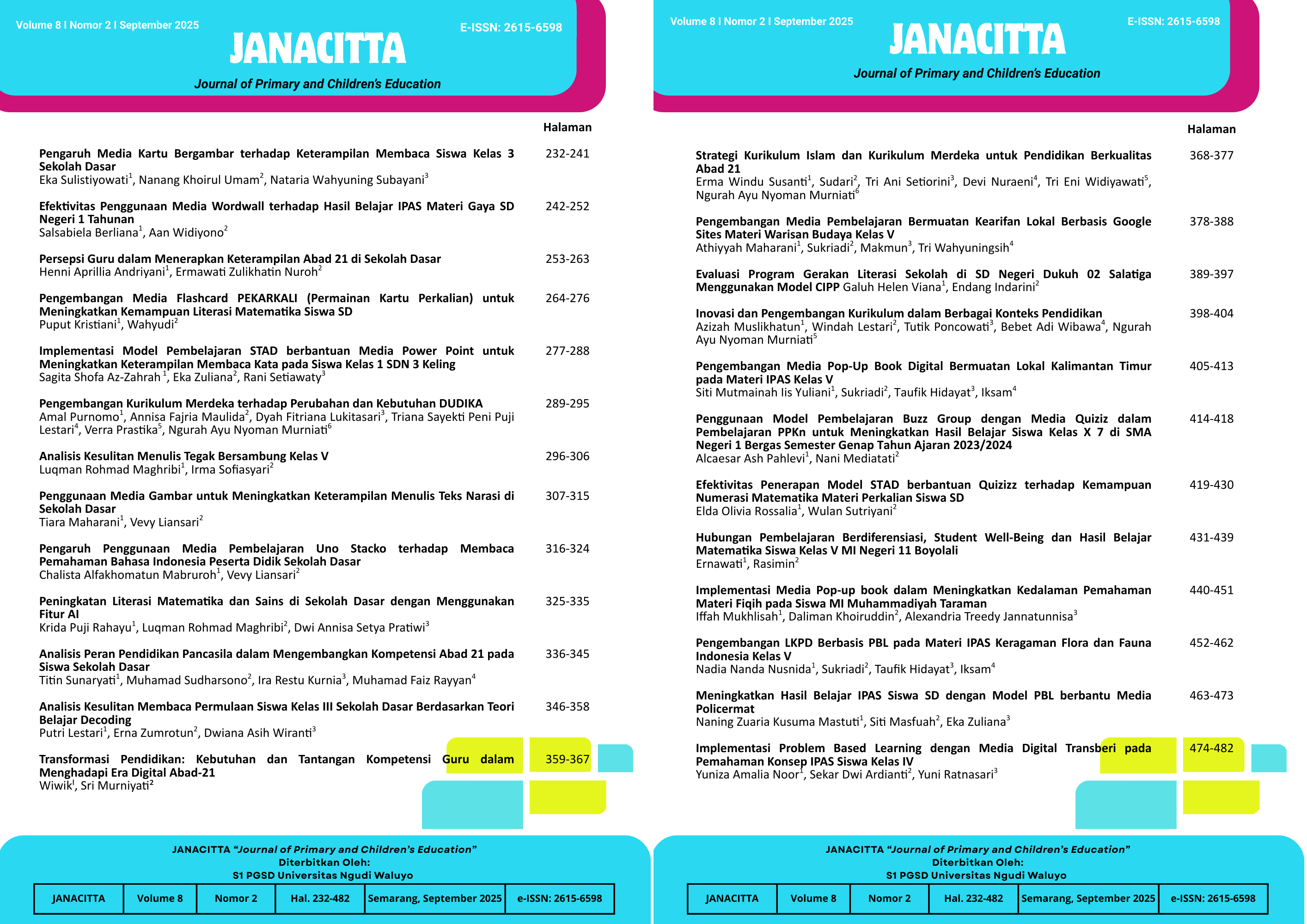
Penggunaan Model Pembelajaran Buzz Group dengan Media Quiziz dalam Pembelajaran PPKn untuk Meningkatkan Hasil Belajar Siswa Kelas X 7 di SMA Negeri 1 Bergas Semester Genap Tahun Ajaran 2023/2024
DOI:
https://doi.org/10.35473/janacitta.v8i2.4294Keywords:
Learning Outcomes, Buzz Group Learning Model, Quizizz, PPKn, High School.Abstract
Abstract
This study aims to improve the learning outcomes of class X7 students of SMA Negeri 1 Bergas in PPKn subjects through the application of the Buzz Group learning model with Quizizz media. This type of research is classroom action research. This classroom action research was conducted in two cycles. With data collection techniques of observation, documentation, and tests. The data analysis technique uses qualitative and quantitative description techniques to describe the improvement in student learning outcomes in cycles I and II. The results showed a significant increase in student learning outcomes. In the pre-cycle, only 58.33% of students achieved KKM ≥75, in cycle I it increased to 72.22% and in cycle II it reached 88.89%. This increase in learning outcomes shows that the use of the Buzz Group learning model with Quizizz media is effective in improving students' PPKn learning outcomes.
Abstrak
Penelitian ini bertujuan untuk meningkatkan hasil belajar siswa kelas X7 SMA Negeri 1 Bergas dalam mata pelajaran PPKn melalui penerapan model pembelajaran Buzz Group dengan media Quizizz. Jenis penelitian ini adalah penelitian tindakan kelas (clasroom action research).Penelitian tindakan kelas ini dilakukan dalam dua siklus. Dengan teknik pengumpulan data observasi, dokumentasi, dan tes. Teknik analisis data menggunakan teknik deskripsi kualitatif dan kuantitatif untuk mendeskripsikan peningkatan hasil belajar siswa pada tahap siklus I dan II. Hasil penelitian menunjukkan adanya peningkatan yang signifikan pada hasil belajar siswa. Pada pra siklus, hanya 58,33% siswa yang mencapai KKM ≥75, pada siklus I meningkat menjadi 72,22% dan pada siklus II mencapai 88,89%. Peningkatan hasil belajar ini menunjukkan bahwa penggunaan model pembelajaran Buzz Group dengan media Quizizz efektif dalam meningkatkan hasil belajar PPKn siswa.
References
Arikunto, S. (2013). Metode Penelitian Kuantitatif Kualitatif dan R&D. Bandung: CV. Alfabeta.
Barkley, R. A. (2012). Excecutive functions: What They Are, How They Work, and Why They Evolved. New York: The Guilford Press.
Farid, F. M., Arnidha, Y., & Budiarti, Y. (2021). Pengaruh Tipe Kepribadian Terhadap Hasil Belajar Matematika dengan Intervensi Metode Time Quiz. JANACITTA, 4(2).
Fauziah, U. (2019). Pengaruh Media Quizizz terhadap Motivasi Belajar Peserta Didik dalam Pembelajaran PKN. Skripsi, Universitas Pasundan Bandung.
Fitri, S., Pionera, M., & Ramdhani, M. T. (2024). Efektivitas Metode Buzz Group terhadap Kemampuan Berpikir Kritis Siswa dalam Pembelajaran PAI. Jurnal Inovasi, 6(3), 288–296.
Haslina. (2022). Penerapan Metode Pembelajaran Diskusi Buzz Group dalam Meningkatkan Hasil Belajar IPS Siswa Kelas IV SD Inpres Bontomanai Kota Makassar. Skripsi, Institut Agama Islam Negeri Kudus.
Kamza, Muhjam, Husaini, dan Ayu Indah Lestari. (2021). Pengaruh Metode Pembelajaran Diskusi dengan Tipe Buzz Group terhadap Keaktifan Belajar Siswa pada Mata Pelajaran IPS. Jurnal Basicedu, 5(5), 4120–4126.
Nurhayati, E. (2020). Meningkatkan Keaktifan Siswa dalam Pembelajaran Daring melalui Media Game Edukasi Quiziz pada Masa Pencegahan Penyebaran Covid-19. Jurnal Paedagogy, 7(3), 145-150.
Rusman. (2015). Pembelajaran Tematik Terpadu: Teori, Praktik dan Penilaian. Jakarta: Rajawali Pers.
Sugiyono. (2016). Metode Penelitian Kuantitatif, Kualitatif, R&D. Bandung: CV. Alfabeta.
Downloads
Published
How to Cite
Issue
Section
License
Copyright notice:
- Authors retain copyright and grant the journal right of first publication with the work simultaneously licensed under Creative Commons Attribution License that allows others to share the work with an acknowledgement of the work's authorship and initial publication in this journal.
- Authors are able to enter into separate, additional contractual arrangements for the non-exclusive distribution of the journal's published version of the work (e.g., post it to an institutional repository or publish it in a book), with an acknowledgement of its initial publication in this journal.
- Authors are permitted and encouraged to post their work online (e.g., in institutional repositories or on their website) prior to and during the submission process, as it can lead to productive exchanges, as well as earlier and greater citation of published work (The Effect of Open Access)